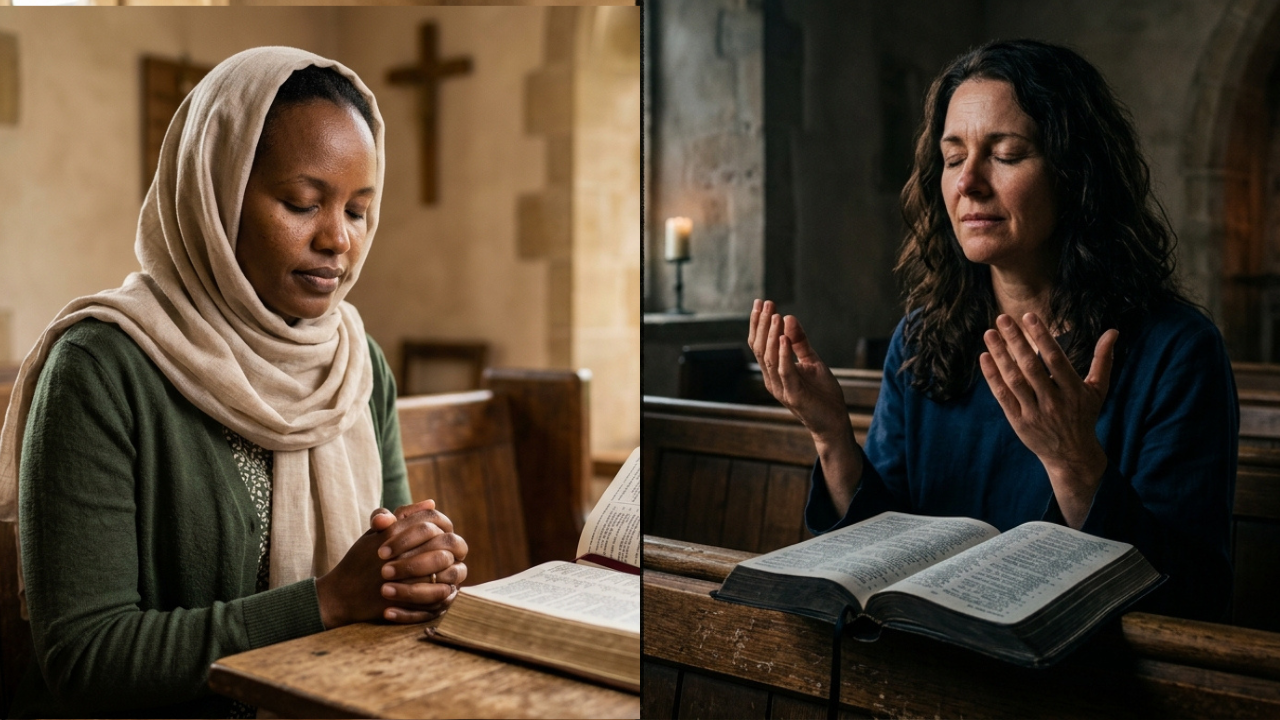
Is It Necessary for a Woman to Cover Her Head for Prayer? A Biblical Explanation of 1 Corinthians 11
The question, “Is it necessary for a woman to cover her head for prayer?” has stirred discussion in churches for centuries. Some believe it is a strict command from God that applies to all women today. Others believe it was cultural and specific to a particular time.
But what does the Bible really say?
As believers, we must not approach this topic with tradition alone. We must approach it with humility, Scripture, and the guidance of the Holy Spirit.
Let us go deep into the Word of God and understand this in a balanced, biblical way.
Where Does the Bible Talk About Head Covering?
The main passage that addresses this issue is in 1 Corinthians 11:2–16. The Apostle Paul writes to the church in Corinth and speaks about authority, honor, and head coverings during prayer and prophecy.
Paul says:
“Every woman who prays or prophesies with her head uncovered dishonors her head…” (1 Corinthians 11:5)
At first glance, this sounds like a clear command. But to understand Scripture correctly, we must understand:
The context
The culture
The spiritual principle behind the instruction
Understanding the Cultural Context of Corinth
The city of Corinth was known for its immoral culture and pagan worship practices. In that society:
Respectable married women covered their heads in public as a sign of modesty and honor.
Women who removed their covering were often associated with rebellion or immorality.
Temple prostitutes commonly appeared unveiled or with certain hairstyles that signified independence from moral standards.
When Paul addressed the church in Corinth, he was guiding believers on how to live in a way that honored Christ and avoided confusion with worldly behavior.
This is very important.
Paul was not introducing a random religious ritual. He was protecting:
God’s order of authority
The testimony of the church
The dignity of women
The unity of believers
What Was Paul’s Main Concern?
Paul connects the head covering to authority and order.
He writes that:
Christ is the head of man.
Man is the head of woman.
God is the head of Christ. (1 Corinthians 11:3)
This does not mean superiority or inferiority. It speaks of divine order.
Just as Jesus Christ submitted to the Father in role (not in value), so Paul speaks about visible symbols that reflect God’s design of authority within worship.
The covering was a symbol of that order.
The deeper issue was not the fabric on the head.
The deeper issue was the heart posture toward God’s authority.
Is This Command Universal for All Time?
This is where Christians differ.
There are generally three main views:
1. The Universal Command View
Some believers say this command applies to all women in all cultures at all times. They practice head covering during prayer and worship today.
This view is commonly found in:
Conservative churches
Some Anabaptist groups
Certain Pentecostal and Holiness traditions
2. The Cultural Application View
Others believe Paul was addressing a specific cultural situation in Corinth. Since head coverings no longer carry the same meaning in most cultures today, they believe the principle remains, but not the physical covering.
In many countries today, a woman covering her head does not symbolize submission or modesty in the same way it did in Corinth.
Therefore, they focus on:
Modesty
Respect
Order in worship
Submission to God
Without requiring a physical veil.
3. The Hair-as-Covering Interpretation
Some interpret verse 15 (“her hair is given to her for a covering”) as meaning that long hair itself is the covering Paul refers to.
However, in the original Greek language, Paul uses two different words for “covering” in the passage, which suggests he may have been speaking of both a natural covering (hair) and an additional covering.
This shows how complex and careful Bible study can be.
What Is the Core Spiritual Principle?
Whether one believes in physical covering today or not, the spiritual principles in this passage are clear:
Honor God’s divine order.
Worship with humility.
Avoid rebellion in the heart.
Protect the testimony of Christ.
Do not use freedom to create confusion.
Paul ends the discussion by saying:
“If anyone is inclined to be contentious, we have no such practice, nor do the churches of God.” (1 Corinthians 11:16)
This suggests he did not want division over this issue.
Unity was more important than argument.
Does a Woman Sin If She Does Not Cover Her Head Today?
This must be answered carefully and honestly.
The New Testament does not repeat this command elsewhere as a universal salvation issue.
There is no passage that says a woman loses salvation for not wearing a head covering.
Salvation is through faith in Jesus Christ, not through external symbols.
However:
If a woman is personally convicted by the Holy Spirit to wear a covering, she should obey her conscience.
If she believes it is cultural and does not wear one, but still walks in modesty, humility, and submission to God, she is not automatically in rebellion.
The real question is not: “Is there cloth on my head?”
The real question is: “Is Christ truly Lord over my heart?”
Why This Topic Still Matters Today
This issue matters because it touches on:
Biblical authority
Gender roles in Scripture
Church tradition
Cultural adaptation
Spiritual humility
In some regions (especially in parts of Asia, the Middle East, and conservative Christian communities), women still cover their heads during prayer out of reverence.
In other parts of the world, this is not practiced at all.
The body of Christ is global.
And we must walk in love toward one another.
A Word of Caution
We must be careful not to:
Judge women who cover their heads.
Judge women who do not.
Turn this into a legalistic burden.
Or ignore Scripture completely out of modern comfort.
The Pharisees focused on outward appearance. But Jesus Christ focused on the heart.
External obedience without internal surrender is empty.
But internal surrender should also reflect in respectful outward conduct.
So, Is It Necessary?
Here is the balanced biblical answer:
It was necessary in Corinth for cultural, symbolic, and spiritual reasons.
The eternal principle of honoring God’s order is still necessary.
Whether the physical covering is required today depends on cultural context, church conviction, and personal conscience under the Holy Spirit.
What is absolutely necessary is:
A covered heart before God.
A humble spirit in prayer.
A life surrendered to Christ.
Final Reflection
If you are a woman asking this question sincerely, pray and ask the Holy Spirit to guide you.
If you are a man debating this issue, approach it gently and respectfully.
The Kingdom of God is not about fabric.
It is about righteousness, peace, and joy in the Holy Spirit.
Let your worship be pure.
Let your heart be covered in reverence.
And let everything you do bring honor to the Lord.