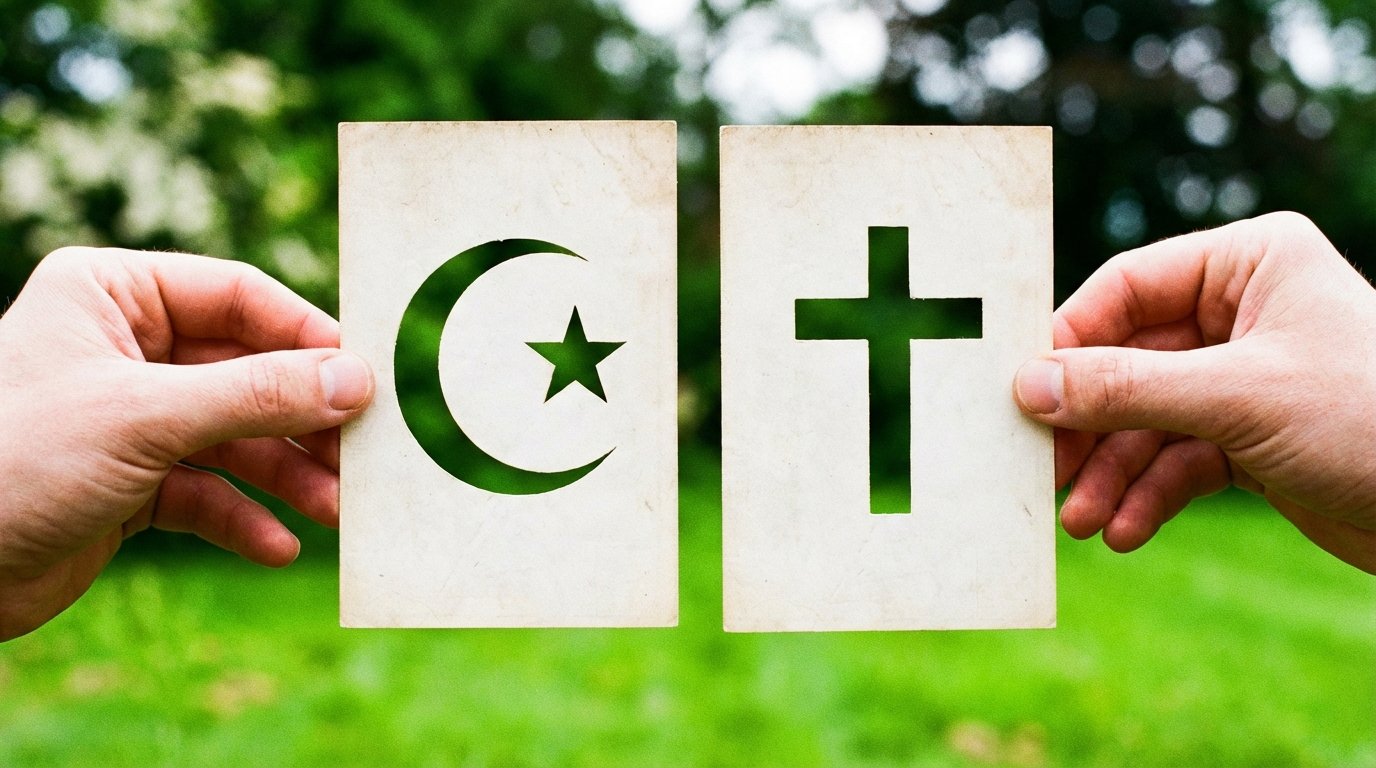
At first glance, the answer may seem simple. Both religions claim to worship one God. Both trace their roots back to Abraham. Both speak of prophets, divine revelation, prayer, and moral accountability.
But when we look deeper, not politically, not emotionally, but theologically, the differences become profound.
This article is not written to attack anyone. It is written to seek truth carefully, respectfully, and biblically.
Let’s examine this question honestly.
The Surface Similarities
Before discussing differences, we should acknowledge the similarities:
Both Christians and Muslims believe there is only one God.
Both believe God created the universe.
Both believe God is powerful, holy, and sovereign.
Both believe in judgment after death.
Both recognize figures like Abraham, Moses, and even Jesus (though very differently).
Because of these similarities, many conclude that Christians and Muslims worship the same God, just with different understandings.
But theology is not built on similarities alone, it is built on identity.
The real question is not: “Are there similarities?” The real question is: Is the God described in the Qur’an the same being as the God revealed in the Bible?
The Central Issue: The Identity of God
The greatest dividing line between Islam and Christianity is not culture. It is not language. It is not a tradition.
It is the nature of God Himself.
1. The Trinity vs. Tawhid
Christianity teaches the Trinity:
One God
Three Persons: Father, Son, and Holy Spirit
Equal in nature, distinct in person
God is eternally relational. God is love (1 John 4:8) — not just loving, but love in His very essence.
Islam teaches Tawhid:
Absolute oneness of God
No division, no persons
God cannot be Father
God cannot have a Son
Associating partners with God (shirk) is the greatest sin
The Qur’an explicitly rejects the Trinity (Surah 4:171; 5:73).
So we must ask:
If one religion says, “God is Triune; Father, Son, Spirit” and the other says, “God is absolutely one and cannot be Father or Son,” Are they describing the same being?
That is not a minor difference. That is a fundamentally different identity.
The Person of Jesus: The Defining Difference
If you want the clearest answer to this question, look at Jesus.
In Christianity:
Jesus is God incarnate (John 1:1, 1:14).
He is the Son of God.
He was crucified.
He rose from the dead.
He is the only way to salvation (John 14:6).
In Islam:
Jesus (Isa) is a prophet.
He is not the Son of God.
He was not crucified (according to mainstream Islamic teaching).
He is not divine.
Salvation is through submission and good deeds.
These are not minor disagreements.
If one faith says: “Jesus is God in the flesh,”
And the other says: “It is blasphemy to call Him God,”
Then we are no longer talking about different views of the same God.
We are talking about different revelations altogether.
The Character of God: Father or Master?
In Christianity:
God is Father. Believers are adopted as sons and daughters (Romans 8:15). There is an intimate relationship.
In Islam:
God is Master. Humans are servants (‘abd). There is submission, but not adoption.
The Qur’an repeatedly denies that Allah is Father.
Yet in the Bible, Jesus teaches us to pray:
“Our Father in heaven…” (Matthew 6:9)
This is not just a difference in terminology, it is a difference in relational identity.
Can Two Different Descriptions Refer to the Same Being?
Some argue:
“Yes, Christians and Muslims worship the same God, but understand Him differently.”
But consider this carefully:
If one group says:
God is Triune
God became flesh
God died and rose again
And another group says:
God is not Triune
God cannot become flesh
God did not die
At some point, the descriptions are no longer compatible.
If two people describe someone:
One says he is a married father of three.
The other says he has no children and cannot have children.
Are they talking about the same person?
The contradiction matters.
What About the Name “Allah”?
Some people argue that “Allah” simply means “God” in Arabic. Linguistically, that is true. Arabic-speaking Christians also use the word “Allah” for God.
However, the issue is not the word, it is the definition behind the word.
The biblical God (Yahweh):
Reveals Himself as Father, Son, Spirit.
Enters into a covenant through grace.
Offers salvation through Christ’s sacrifice.
The Qur’anic Allah:
Is strictly singular.
Denies sonship.
Denies the crucifixion.
Grants salvation based on submission and deeds.
Same word? Possibly. Same nature and revelation? That is where the disagreement lies.
A Respectful but Honest Conclusion
From a biblical Christian perspective:
Muslims and Christians do not worship the same God in terms of revealed identity.
Why?
Because the identity of God is inseparable from:
The Trinity
The Divinity of Jesus
The Cross
The Resurrection
If these are denied, the nature of God being worshiped is fundamentally different.
That does not mean Muslims are insincere. It does not mean they are not seeking God. It does not mean Christians should respond with hatred.
It means truth matters.
And truth must be spoken in love.
Why This Question Matters
This is not just a theological debate.
It affects:
Salvation
The nature of worship
The person of Jesus
The understanding of grace
Jesus said:
“If you do not believe that I am He, you will die in your sins.” (John 8:24)
Christian faith stands or falls on who Jesus is.
If He is not God, Christianity collapses. If He is God, then denying Him changes everything.
Final Thoughts
So, do Muslims and Christians worship the same God?
On the surface level, both claim to worship the one Creator.
But on a theological and biblical level, the revealed identity of God in Christianity and Islam is fundamentally different.
And when identity differs, the object of worship differs.
As believers, we must:
Speak with clarity
Stand on Scripture
Show love
Pray for understanding
Trust the Holy Spirit to reveal truth
Truth without love becomes harsh. Love without truth becomes compromise.